Back Rank Checkmate
Back rank checkmate is a chess checkmate where a king is trapped on its back rank and cannot escape because its own pawns block the way. A rook or queen delivers checkmate, and the king cannot capture the attacker, block the check, or run away.
Back rank checkmates: we all love them, as long as we’re not the ones getting checkmated! These classic traps can catch anyone off guard, especially when you forget to give your king a little space to breathe. In this article, we’ll learn all about this sneaky and satisfying checkmate.
Here is what you will learn in this article:
- What Is A Back Rank Checkmate?
- Why Is It Important To Learn The Back Rank Checkmate?
- Key Characteristics Of A Back Rank Mate
- How Does A Back Rank Mate Happen?
- How To Deliver A Back Rank Mate
- How To Prevent A Back Rank Mate
- Create "Luft" For Your King
- Keep A Guard On The Back Rank
- Use Prophylaxis
- Watch Out For Overworked Pieces
- Test Your Skills
- Wrapping Up
- Back Rank Mate Video
What Is A Back Rank Checkmate?
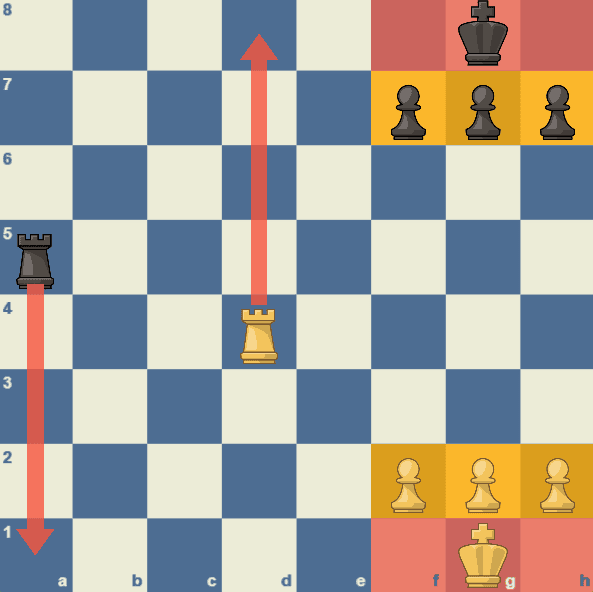
A back rank checkmate happens when a king is trapped on the back row (the first rank for White, the eighth rank for Black) and is checkmated by a rook or queen. Usually, the king can’t escape because three of its own pawns are blocking the way. This pawn wall is sometimes called a blanket, and it’s cozy… until it’s not!
FunMaster Mike explains it perfectly in his lesson below: After castling, the king looks safe, wrapped in a blanket of pawns. But without "luft" (air), the king has nowhere to run when a rook sneaks down the file. That’s when the checkmate strikes!
Why Is It Important To Learn The Back Rank Checkmate?
Knowning the back rank mate pattern teaches you to:
- Recognize weak squares and tactical threats
- Understand the danger of unmoved pawns near your king
- Spot classic tactical ideas in puzzles and games
- Learn how coordination between pieces leads to victory
- Play smarter by knowing what to watch out for
Key Characteristics Of A Back Rank Mate
The setup is simple but dangerous:
- The king is stuck on the back rank (A).
- Its escape squares are blocked by its own pawns or attacked by the opponent (B).
- A rook or queen delivers the final check (C).
- There are no pieces available to block or capture the attacker (D).
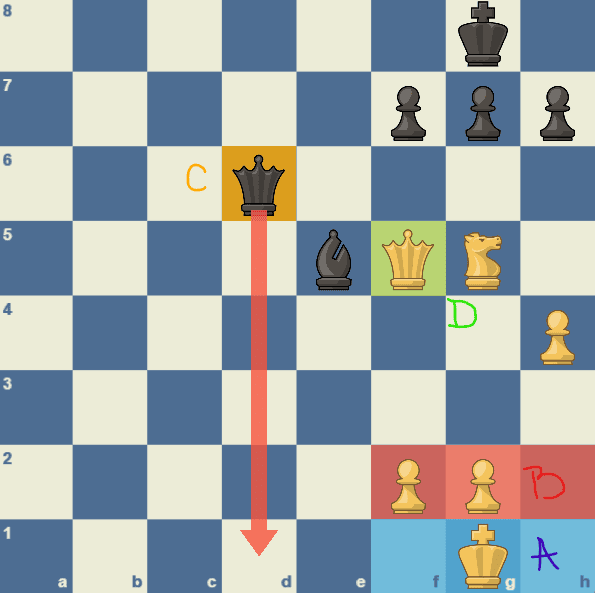
It’s a pattern you’ll see in both beginner games and high-level tactics. Once you know it, you’ll recognize it quickly.
How Does A Back Rank Mate Happen?
This checkmate usually happens when a player forgets to make space for their king or becomes too focused on attacking without checking their own safety.
The Pawn Shield
Most back rank mates in chess occur because the three pawns in front of the king haven’t moved. These pawns block the king’s escape path.
A Vulnerable Back Rank
Once your opponent notices that your king has no way to escape, all it takes is a rook or queen to slide onto the rank and deliver checkmate.
Piece Coordination
Back rank mates often appear in combination with other tactics, like pins, skewers, or decoys. Make a plan to remove defenders and break through to the back rank.
How To Deliver A Back Rank Mate
Don’t worry, this checkmate isn’t complicated. As FunMaster Mike likes to say, if you know what to look for, you can divide the back rank mate into just three simple steps… and no, your rook doesn’t need a GPS to find the king!
Step 1: Set Up The Trap
Start by opening a file. As FunMaster Mike says, rooks love open lines! A common setup is placing a rook on an open file and aiming toward the opponent’s king.
Example: White moves the rook to e1. Now the e-file is ready for action, so don't take the pawn; it is a trap!
Step 2: Use A Rook Or Queen
The most common way to checkmate is with a rook sliding down the open file. Sometimes a queen does the trick too, especially when the rook is busy, or you're combining tactics.
In one of Mike’s examples, a rook captures a knight, an important sacrifice. Why? Because the opponent’s rook was guarding both the knight and the back rank. That’s called an overworked piece.
Step 3: Make Sure The King Can’t Escape
Double-check that the king has no luft. If pawns are on f7, g7, and h7, and none have moved, then the king is trapped. That’s your moment! Deliver the check, and if there’s no way to Capture, Protect, or Run (CPR), it’s checkmate.
Bonus tip: Two rooks working together can create a battery, where one rook supports the other. That’s extra power for your checkmate attack!
How To Prevent A Back Rank Mate
Here are a few simple ways to prevent a back rank checkmate.
Create "Luft" for Your King
This means creating a breathing space. Moving one pawn (usually h3 or g3 for White; h6 or g6 for Black) can give your king an escape square and stop back rank threats.
Keep A Guard On The Back Rank
Always check if your opponent can reach your back rank with a rook or queen. If your king is stuck and your back rank is unguarded, protect it before it’s too late.
Use Prophylaxis
Prophylaxis means thinking ahead and stopping your opponent’s ideas before they become dangerous.
Watch Out For Overworked Pieces
Sometimes a piece is guarding two things at once. If it leaves the back rank to help somewhere else, it might be checkmate next move.
Test Your Skills
Are you ready to solve some chess problems related to this checkmate? Practice with dedicated back rank mate puzzles.
Wrapping Up
The back rank mate is a must-know checkmate pattern. It happens when you least expect it—and it can turn a close game into a quick win. Whether you're setting the trap or escaping one, remember what you've learned.
Remember:
- A king trapped behind its own pawns is in danger. Watch those blanket pawns!
- Rooks and queens are strong back rank attackers. Use them wisely!
- Always look for ways to defend and attack. Keep your king safe with luft!
- Practice the pattern to master it. Don’t let your pieces get overworked!
Back Rank Mate Video
Want to see FunMaster Mike’s back rank tricks in action? Watch the full video here: